Our Research

NTS is focused on the scientific validation of the LSP — analyzing its effectiveness under industry-standard guidelines, with outcomes that improve our understanding of its clinical application and the adjustments required for unique demographic and occupational groups.

A Validated Approach to Technique Development

The development of the LSP has been an iterative, evidence-informed process — beginning with years of clinical observation and progressing through structured pilot studies using industry-standard self-report instruments. Each phase of research has refined our understanding of what works, for whom and why.

Pilot Studies

Our first step in establishing the LSP as a valid approach for the mitigation of stress related conditions was to examine how this modality would function as an isolated approach without the typical multi-system differential diagnosis. Since the LSP was designed as a single system manual therapeutic intervention, there were questions about the safety element that had to be evaluated. Our first pilot, called LSP Pilot 0.9 was designed to put a large quantity of clients through the basic protocol to chart their progress, reactions, and overall response to receiving the LSP. 

Our first observation was that the safety of receiving the LSP was not only validated, there were remarkably few instances of symptomatic flare following the LSP. More than 600 individuals participated in this pilot which ran from December of 2023 to December of 2024. The criteria for participation was simple. We required them to have the experience of long standing psychological stress surrounding an event or trauma that had persisted well beyond the acute phase of injury and had become a chronic source of stress or even contributed to elevated, long standing allostatic load.

90% of the participants reported improvements in overall wellbeing and reduced perception of psychological strain and stress. 5% reported temporary increased psychological strain and stress, nightmares and general anxiety that resolved to a lower than baseline level after a period of 3 days. And the remaining 5% reported no change.

End result, the LSP has been validated for safety for a wide variety of conditions involving psychological strain and stress. It can be used in situations where there is a history of concussion, TBIs or even in neuro-degenerative conditions, but these conditions usually will require additional systems of work to be applied to address the multiple layers of dysfunction that often accompany the more physically involved nature of head injuries.

See All Pilot Study Documents →

Study Label
Pre-Pilot — Safety, Efficacy & General Client Feedback (Pilot 0.9)
Date Range
December 2023 – December 2024
Participants
Approximately 600 individuals
Instruments Used
Self-report only (no validated instruments). General feedback: How did you feel after? Positive or negative changes noted?
Key Finding
Approximately 90% of participants reported feeling better — including improvements in relaxation, perceived stress reduction, decreased anxiety, lowered levels of depression and improved sleep.
Notes/Caveats
Data collection was informal during this pre-pilot (0.9) study. This stage of development was to determine safety and establish a general level of efficacy prior to the first formally instrumented pilot.

Study Label Pilot
Safety and Efficacy & specific self report measurments taken with industry standard mechanisms.
Data Range
Pilot 1.0 March 2025 – April 2025; Pilot 2.0 February 2026 – March 2026; Pilot 3.0 March 2026 - April 2026
Participants
24 active duty law enforcement individuals volunteered to participate in the three formal pilot studies
Instruments Used
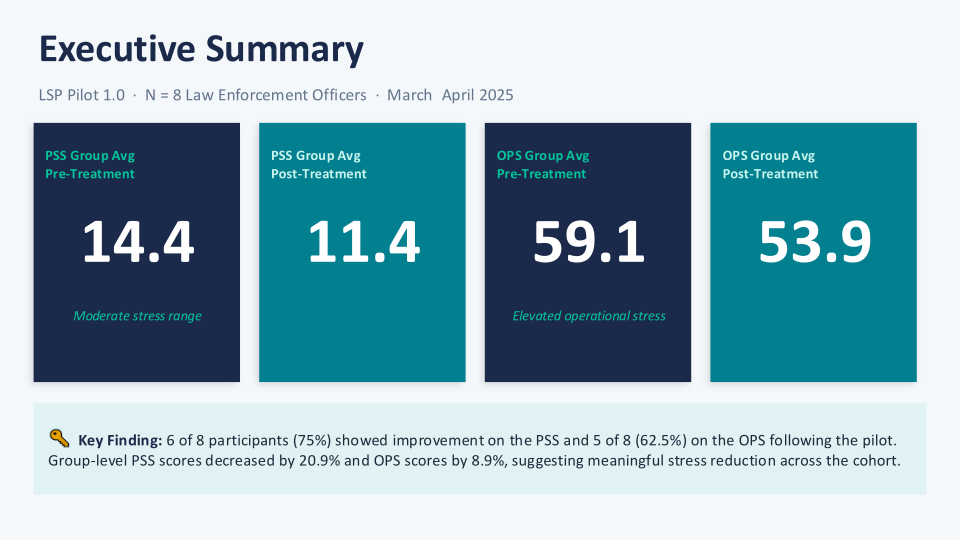
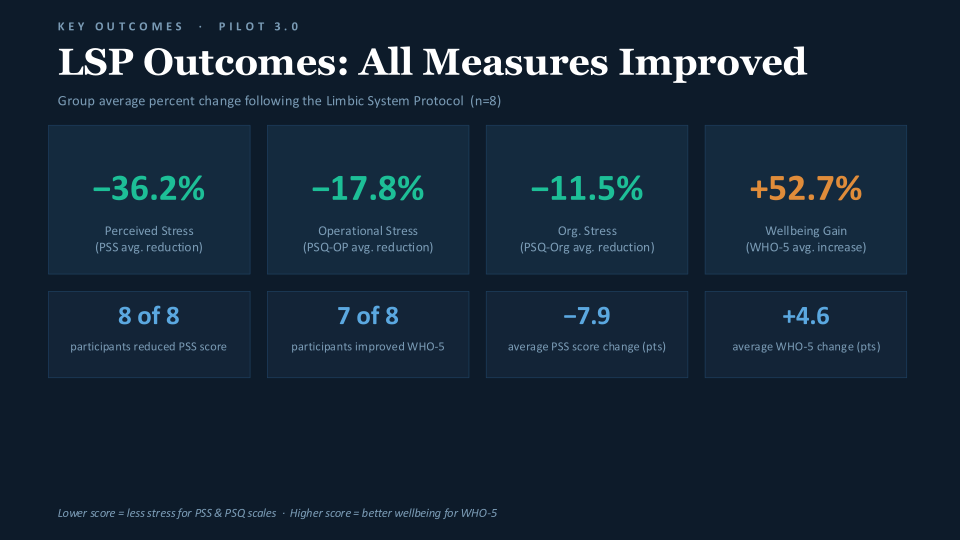
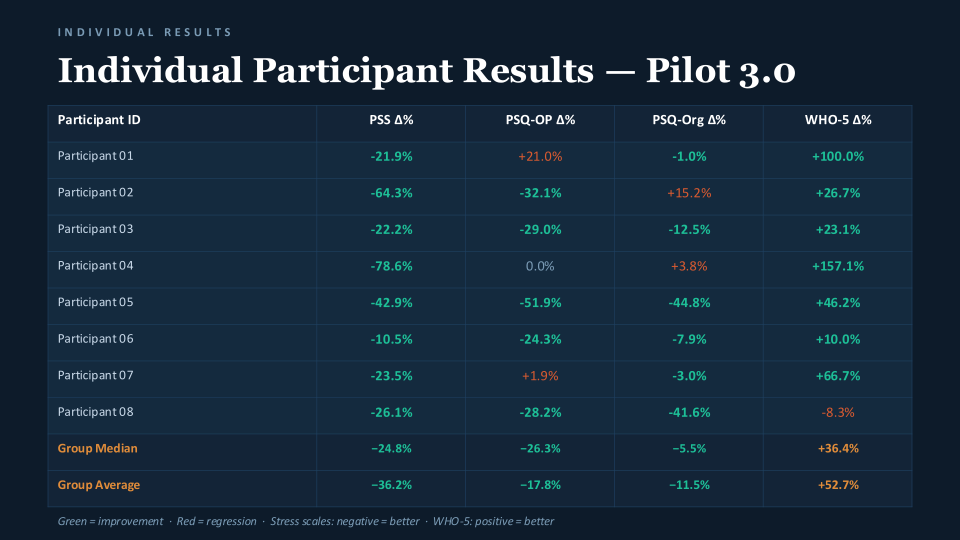
PSS-10 (perceived stress scale), Police organizational stress questionnaire, Police operational stress questionnaire, WHO-5 (wellbeing index)
Key Finding
8 out of 8 participants in pilot 1.0 and pilot 3.0 reported significant reductions in perceived stress. 7 out of 8 report substantial increases in their general sense of wellbeing.
Notes/Caveats
Data collection was formalized and protected during this study. This stage of development was to determine how effective the LSP is at reducing perceived stress among a group of very high stress individuals involved in active duty law enforcement.

Study Label
TBD

Researched and Validated

Research conducted using members of the SRT to perform the LSP for active duty law enforcement officers from three different local law enforcement agencies in the Portland Metro Area. Pilot's 1.0 and 3.0 involved 4, one hour sessions performed one time a week for four weeks. Pilot 2.0 was a condensed study involving only 2, one hour sessions performed one time a week for two weeks. Post LSP data was recorded exactly one week after the final LSP session was administered.